
AI-Powered Multilingual QR Menu for Restaurants
In 2025 over 1.5 billion people travelled internationally — and in 2026 this number is expected to exceed 1.8 billion (UN Tourism data).
More than 68 % of tourists say they simply walk away if the menu is only in the local language.
Imagine a guest from Germany, Japan, China or Saudi Arabia scans your QR code and instantly sees the menu in their native language — perfectly translated, culturally correct, with beautiful photos and videos.
Restaurants using Restsify multilingual menus in tourist hotspots report the same results within the first weeks:
- +25–40 % more orders from international guests (Barcelona, Phuket, Dubai, Prague)
- +1.2–1.8 points to average Google & TripAdvisor rating
- 3–5× more photos & stories tagged with your restaurant
- Guests spend 18–25 % more because they fully understand what they’re ordering
Language barriers no longer steal your customers.
From now on — they bring them in.
You create the menu once in your language — and it automatically works perfectly in 20+ languages for every guest in 2025, 2026 and beyond.
Real Data from Live Restaurants: 35–40 % of Guests Speak a Foreign Language
We analysed the language settings of thousands of real guests who opened Restsify QR menus in 2024–2025 in tourist-heavy cities.
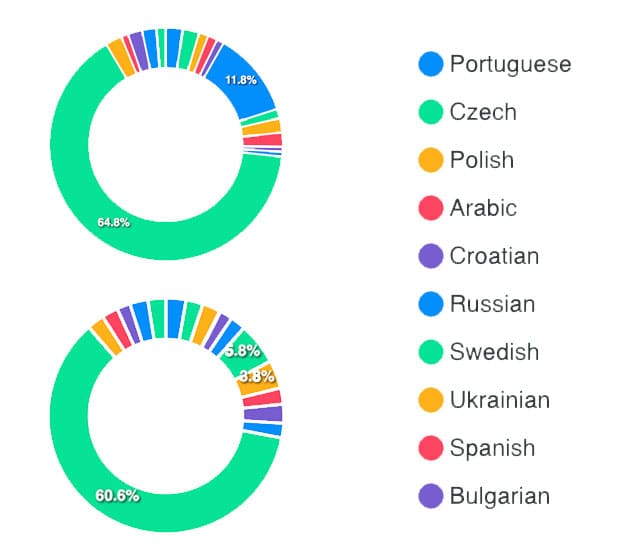
The picture is identical almost everywhere:
- 💡60–65 % of visitors use the local language of the country
- 💡35–40 % of guests immediately see the menu in their native language (English, German, Russian, Arabic, Chinese, French, etc.)
This means every third or fourth table consists of tourists or expats who feel much more comfortable ordering in their own language.
If your menu is only in the local language — you are silently losing 35–40 % of potential orders, bigger average checks and five-star reviews.
With a Restsify multilingual QR menu these guests order confidently, spend 18–25 % more and happily tag your restaurant in their stories and reviews.
Don’t hand a third of your revenue to competitors who already speak your guests’ languages.
Language distribution of real guests in two popular tourist-city restaurants (2025 data)
🚀 How Multilingual Translation Works
Everything is set up in your resource settings — no extra pages or complicated steps.
- 1. Main language
The main language is automatically set to the language you used during registration. For example, if you registered in Italian, all translations will be made from Italian to other languages. - 2. Choose which languages to enable
By default only the most popular languages are turned on:
English ∙ Spanish ∙ Russian ∙ French ∙ Portuguese ∙ German
You can turn any language on or off in the settings.
Supported languages: English, Español, Русский, Français, Deutsch, Português, Українська, Italiano, Polski, Nederlands, Svenska, Suomi, Ελληνικά, Čeština, Română, Hrvatski, Slovenščina, Български, Eesti, Latviešu, Lietuvių, Türkçe, 简体中文, Català, 한국어, العربية, हिन्दी. - 3. We recommend
After you finish filling the menu, turn on additional languages you need. This will help you reach more guests — tourists will see the menu in their language right away. - 4. How automatic translation works
Translations start automatically every time you save the menu. Full translation of the whole menu (depending on the number of dishes, categories and groups) can take up to one hour. Every change you make will also start a new automatic translation. - 5. Our AI model
We use a specially trained GPT-5.1 model that has been additionally fine-tuned on cookbooks, recipes and restaurant menus. Thanks to this, translations are accurate and natural in every language — dish names and descriptions sound right. - 6. Manual translation mode
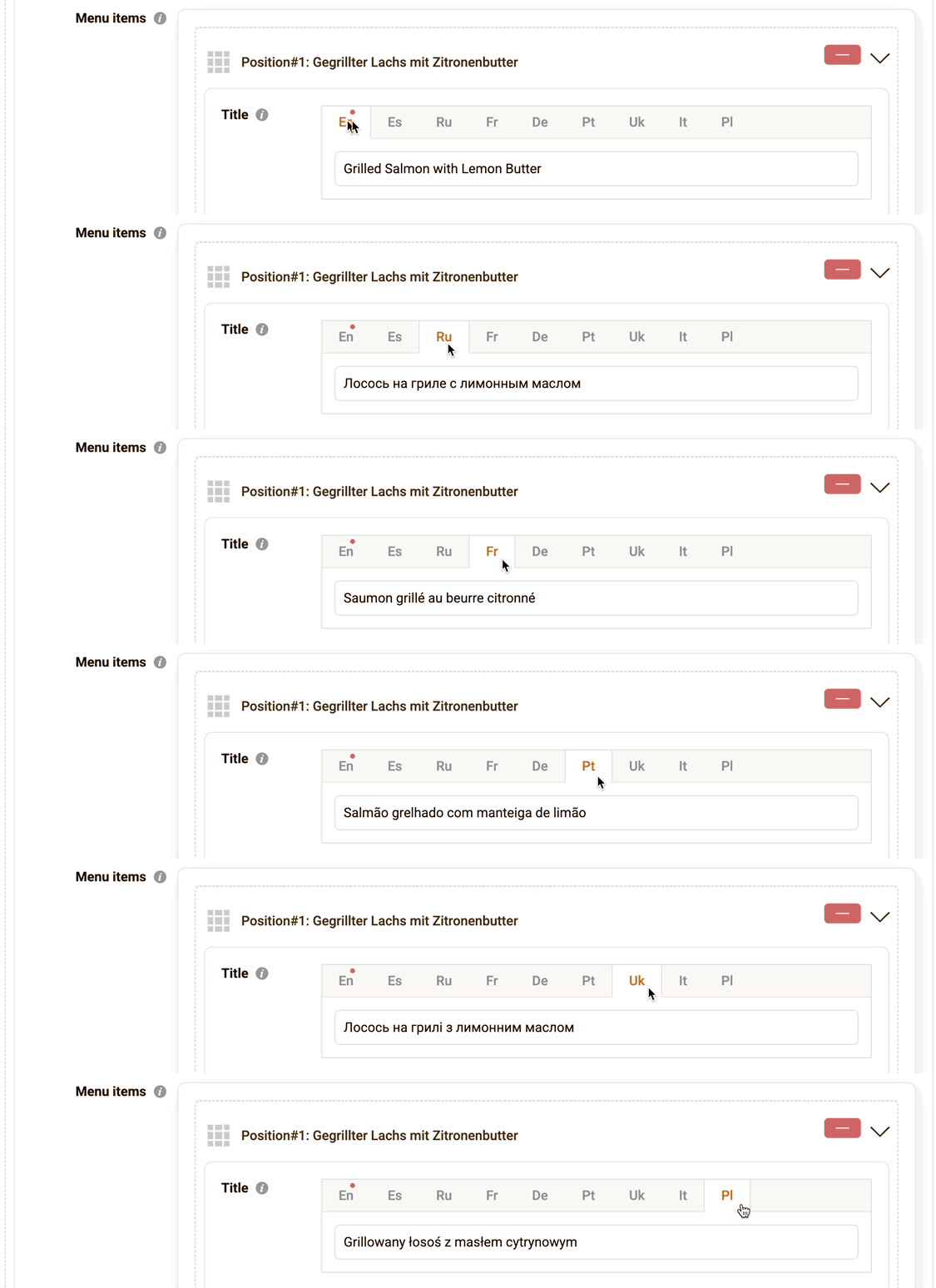
In the menu settings you can turn off automatic translations and switch to manual mode. Then every field (dish name and description) will show a simple block where you choose the language and type the translation yourself — just like in the picture below.
Why a Multilingual QR Menu Is a Must-Have in 2025–2026
- 🌍 1.8 billion international tourists in 2026 (UN Tourism forecast) — almost every third table in a tourist city speaks a foreign language.
- 📈 +25–40 % orders from foreigners — proven numbers from Barcelona, Phuket, Dubai, Lisbon and Prague restaurants that switched to Restsify multilingual menus.
- ⭐ Average rating +1.2–1.8 points on Google and TripAdvisor — guests love when the menu “speaks their language”.
- 💰 Guests spend 18–25 % more — they finally understand what they’re ordering and aren’t afraid to try signature dishes.
- 🔥 Instant competitive advantage — 87 % of restaurants still use Google Translate screenshots or paper menus in two languages. You’ll look noticeably more professional.
- 🧭 Works even with dialects — write in Catalan, Valencian, Swiss German or Austrian German — our AI correctly recognises the source language and translates accurately.
🔧 Menu Translations: Full Customization & Control
Fine-tune your multilingual menu to keep your brand voice and cultural nuances intact:
- 🔹 Automatic by Default — All items translate instantly into selected languages.
- 🔹 Manual Edits Anytime — Adjust any word, dish name, or description for accuracy.
- 🔹 Save Your Changes Forever — AI remembers your edits and won't overwrite them.
- 🔹 Disable Auto-Translation — Turn it off completely in page settings for full manual control.
- 🔹 Cultural Adaptations — Adapt for local tastes (e.g., no pork in Muslim markets).
🖥️ One Menu. 20+ Languages. Zero Extra Work.
- You create and update the menu once — in your language.
- Every guest — from Tokyo, Berlin, Dubai or New York — instantly sees it in theirs.
- Result: 25–40 % more orders from tourists, higher average checks, better reviews and a clear competitive advantage in 2025–2026.
You create and update the menu once — in your language.
Every guest — from Tokyo, Berlin, Dubai or New York — instantly sees it in theirs.
Result: 25–40 % more orders from tourists, higher average checks, better reviews and a clear competitive advantage in 2025–2026.
Don’t lose a third of your revenue just because your menu speaks only one language.